
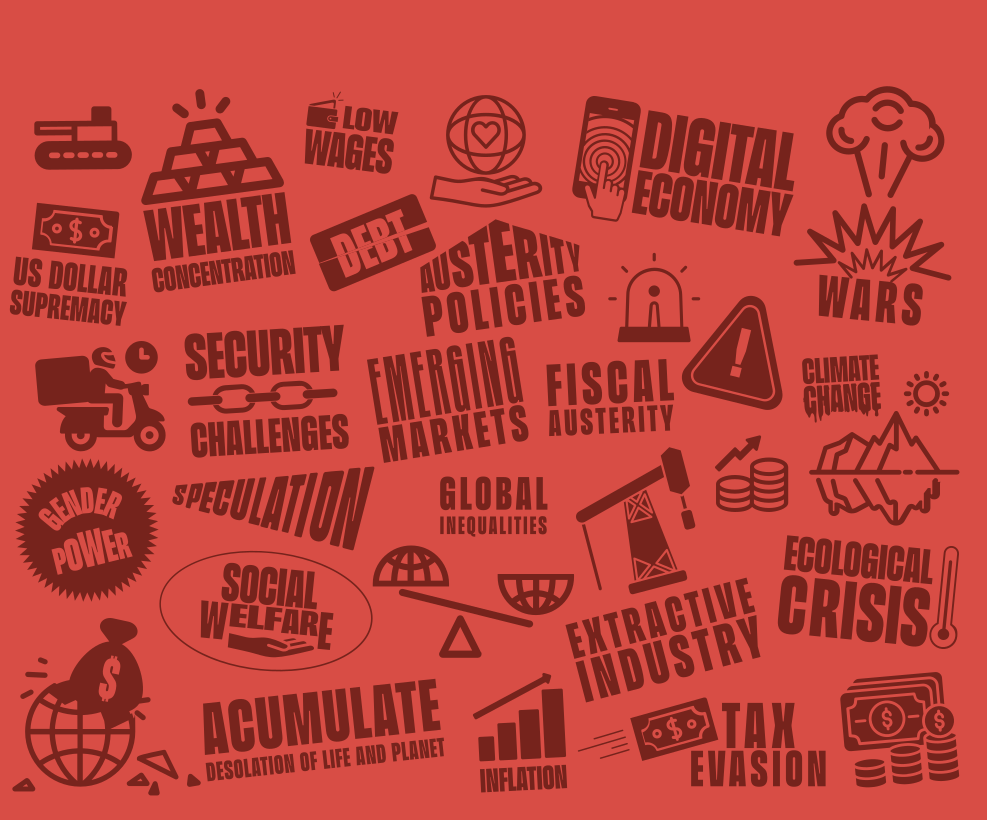
In recent decades, especially since the COVID-19 pandemic, the world has experienced significant transformations driven by rapid technological change, shifts in global value chains, challenges to international trade, increasing financialisation and changes in work processes. At the same time, the private sector, particularly through transnational corporations and financial investment firms, has increased its influence by taking advantage of prevailing macroeconomic policies to position itself as crucial for post-pandemic recovery.
In this context, we wonder: Are current fiscal consolidation, austerity measures and debt regimes merely a repetition of past strategies (like Structural Adjustment Programmes), or do they indicate new dynamics? Is deglobalisation occurring, and what are its implications for the global social sexual division of labour? What fuels financialisation, and how does it affect livelihoods? How do these changes threaten planetary boundaries, and exacerbate inequality and gender disparities?
What are the roles of the States, International Financial Institutions (IFIs) and other key actors in this new context, including in relation to contested issues around taxation and financial flows?
Following DAWN’s tradition, we want to approach these questions from a Global South Feminist perspective.
A Feminist Approach to Macroeconomics
This project updates and strengthens the global South feminist analysis of current and emerging macroeconomic dynamics, their main issues and the challenges they impose.
The project’s conceptual framework challenges orthodox approaches to macroeconomics by expanding the dialogue with alternative heterodox views, referencing different methodologies and going beyond traditional economic models and indicators like Gross Domestic Product (GDP).
It integrates three key dimensions:
Examining the entire economic
system, highlighting the
interdependence of production,
reproduction, financial capital, and state regulation, rather than just focusing on the care economy and households.
Applying an intersectionality perspective to identify, understand, explain and support the transformation of critical economic and gender power relations.
What kind of state is needed for feminist transformation? We examine the state as both a status quo enforcer and a potential driver of change, captured by finance and corporations. Is there any space for transformation driven by civil society and other social actors?
Finding the questions
To begin the project, DAWN hosted a workshop in Bangkok in September 2023 to examine current issues, facilitate collective brainstorming, and generate a list of core questions to guide the research. Discussions focused on six key thematic areas, exploring issues requiring further examination, and identifying implications for a feminist framework. Three key questions emerged:
How does the financial system function globally, nationally and locally and what are the resulting polycrises with negative impacts on the ecosystem, populations, states and development?
1
Who are the significant actors, and what are the roles, relations and processes that drive these current polycrises?
2
What is a feminist alternative to the current system, and how do we build a movement with allies and strengthen feminist narrative power to challenge the entrenched narratives and dynamics driving these polycrises?
3
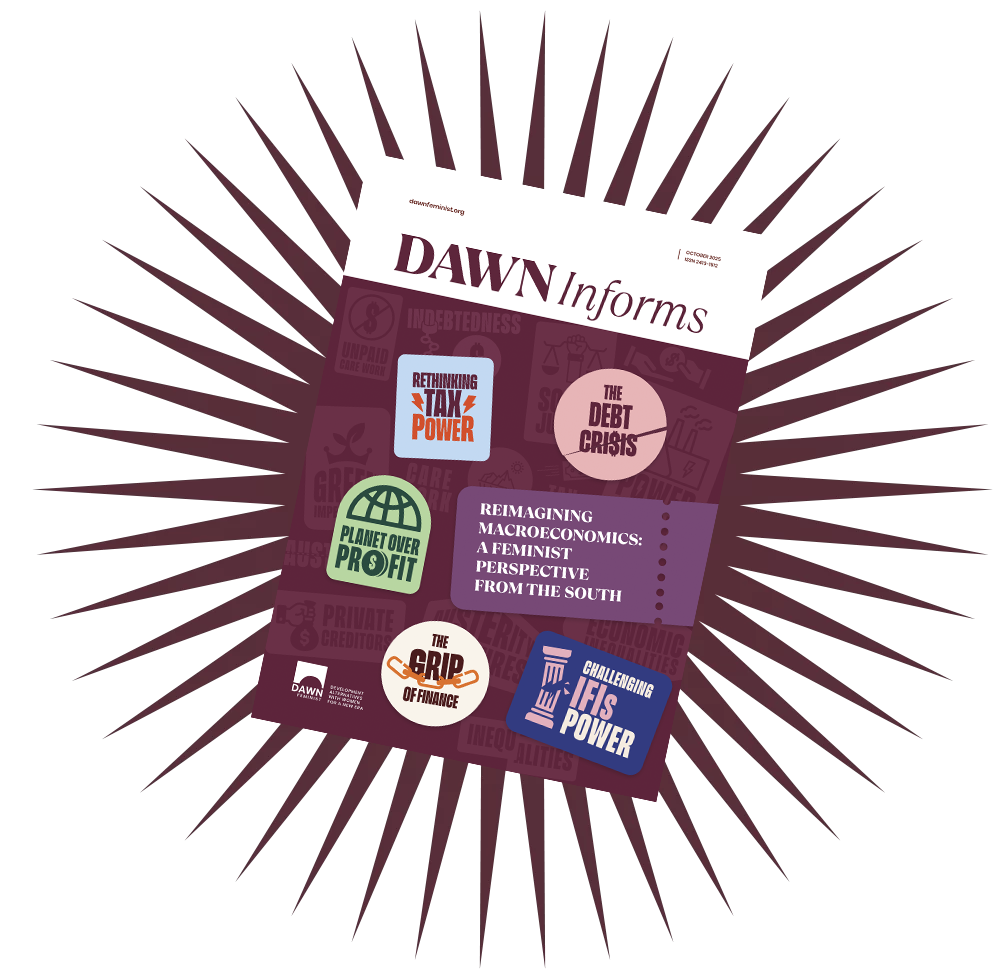
Reimagining Macroeconomics: A Feminist Perspective from the South
This issue of the DAWN Informs presents the main findings of six case studies produced under DAWN’s research project on Global South Feminist Perspectives on Macroeconomics.
“Financialisation is a global phenomenon, marked by heterogeneous forms but a single logic, and it has not spared the periphery of capitalism.“
Lena Lavinas
Discussion Papers
Authors from across the global South have developed a series of discussion papers around key issues. They examine the current state, the origins and drivers of the specific problem and contestations. Importantly, they consider feminist alternatives and remaining questions.



The project is still in progress. Initial findings are being shared through an issue of DAWN INFORMS, the discussion papers above, and through a summary of discussions among project associates that took place in internal webinars.


